Abstract
Many practical CFD problems in industry and research attain crucial physical situations. In the recent decades all CFD research efforts were directed towards the development of numerical techniques that are able to solve these situations accurately. To accurately predict flow properties the solution technique should be able to handle the interactions between high/low speeds, compressible/incompressible, subsonic/transonic/supersonic flows.
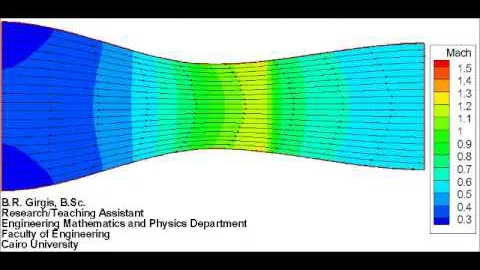
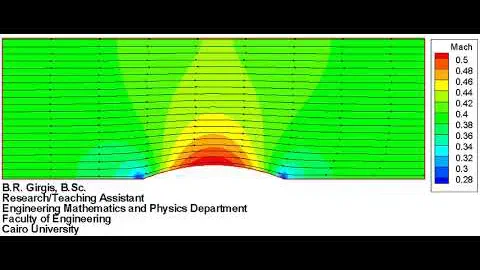
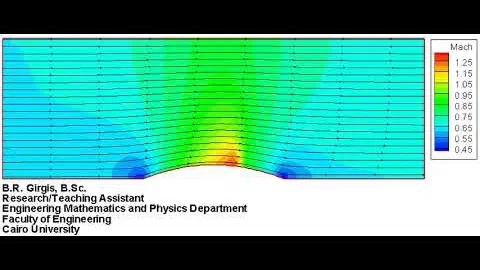
The present thesis aims at developing time accurate flow solver for Euler equations. This solver should be able to operate on different flow regimes seamlessly. The capabilities of the flowfield-dependent mixed explicit/implicit scheme, also known as flowfield dependent variation (FDV) method, have been investigated. Finite element techniques have been used to discretize the flow domain via standard Galerkin method. Several benchmarks have been tested. These test cases have been selected to clarify the ability of the FDV method to resemble complex flow situations and to cover a wide range of flow regimes. Good agreement with published literature has been obtained in all cases.
Try the first benchmark
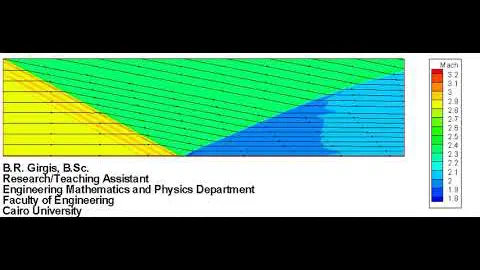
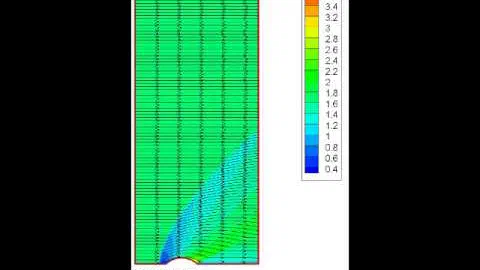
The thesis starts with a shock reflection: a Mach 2.9 stream turned by an incident shock at 29°, which reflects off a wall. The preview below draws the exact solution from the oblique-shock relations. Move the sliders to change the free-stream Mach number and the turning angle. When the wall asks for more turning than the flow behind the first shock allows, the reflection becomes a Mach reflection, which only a full flow solver can capture.
Regular reflection. Incident shock at 29.0°, reflected shock at 23.3° to the wall. Pressure rises 4.11× across both shocks.
I’m porting femslvr, the finite element FDV solver from my Ph.D. work, from Fortran to C++ and WebAssembly. When it ships, this section will run the solver itself on all of the thesis benchmarks, right in the browser.
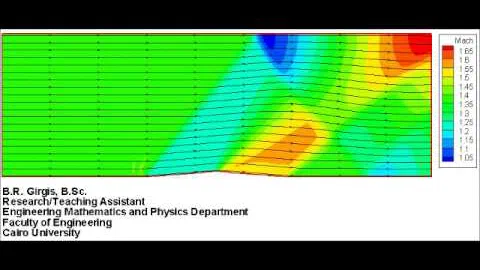
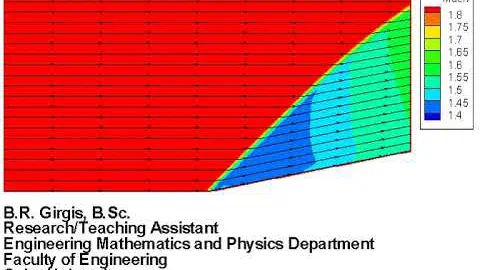
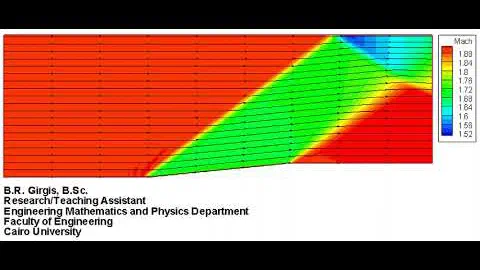
Simulation videos
The thesis test cases, computed with the FDV finite element solver.
Teaching
Engineering Mathematics and Physics Dept.,
Cairo University
Mechanics 1.A:
- Vector algebra and its application to solid geometry
- Force and resultant of a system of forces in space
- Moments of forces and couples
- The equivalent force - couple systems the wrench
- Equilibrium of particles and rigid body subjected to:
- Coplanar forces
- System of three-dimensional forces and couples
Mechanics 1.B:
- Kinematics of a particle: Displacement, velocity and acceleration of particle in Cartesian, intrinsic and polar coordinates. Applications on rectilinear and curvilinear motion
- Kinetics of a particle: Newton’s laws of motion. Applications on circular motion of a particle, projectiles, rectilinear oscillatory motion of a particle, gravitational forces and satellites
- The principle of work and kinetic energy
- Conservation of mechanical energy theorem
- Principle of linear impulse and momentum for a particle and application on collision of particles
Mechanics 2:
- Planar kinematics of a rigid body: Center of mass. Moments of inertia
- Planar kinetics of a rigid body: Linear and angular equations
- Applications of the equations of motion of rigid body: Translation. Rotation about a fixed axis. General plane motion
- The principle of work and kinetic energy
- Conservation of mechanical energy theorem
- Principle of impulse and momentum for a rigid body
- Introduction to vibrations